




How AI Rewrites Global Competitiveness: Key Insights from Satya Nadella, CEO of Microsoft, at WEF Davos 2026

At the 2026 World Economic Forum in Davos, Larry Fink, the Chairman and CEO of BlackRock, sat down with Satya Nadella, the CEO of Microsoft, for a wide‑ranging interview that offered one of the more thought‑provoking exchanges of the week. In a setting defined by geopolitical uncertainty and rapid technological change, Fink invited Nadella to reflect on how artificial intelligence had moved from a distant concept to a central force shaping the global economy. Their discussion offered a clear, grounded look at how one of the world’s most influential technology leaders viewed AI’s role in transforming competitiveness, productivity, and the future of work.
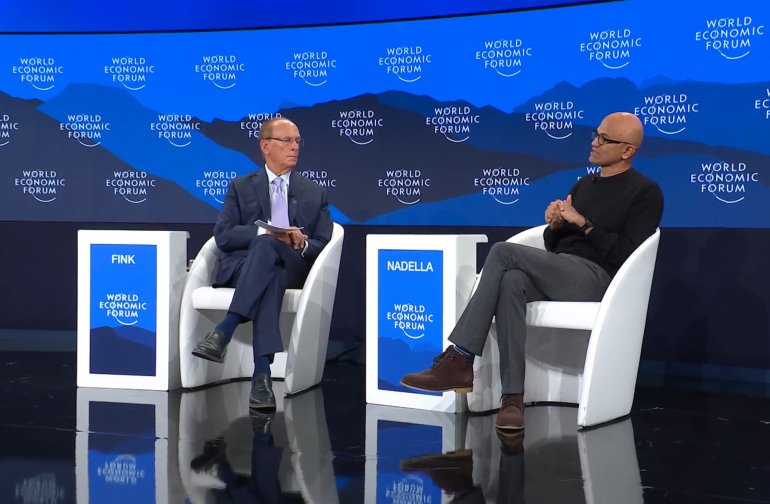
Table of Contents
- AI’s Transition From Experiment to Foundation
- AI Within the Long Arc of Computing
- From Predictive Coding to 24/7 Autonomous Workflows
- AI as an Extension of Human Agency, Not a Replacement
- AI and the New Fluidity of Software Creation
- AI Diffusion as the Key to Meaningful Impact
- AI as the Next Great Cognitive Amplifier
- Skilling as the Engine of AI Diffusion
- AI’s Promise Rests on Making Its Power Truly Universal
- AI Diffusion, Not Invention, Will Decide AI’s Global Winners
- Why AI Requires a New Mindset, New Skills, and New Organizational Design
- Why Context, Not Just Models, Determines AI’s Real Impact
- Why AI Levels the Playing Field Between Startups and Giants
- Why Global Know‑How Looks Similar, but Adoption Still Varies by Country
- The Countries That Produce the Cheapest Tokens Will Capture the Most Growth
- Why Europe Must Leverage Its Industrial Data, Not Just Guard It
- The Real Sovereignty Question in AI: Who Controls the Model, Not Where the Data Lives
- The Future of AI Is Multi‑Model — And Orchestration Becomes the New IP
- Conclusion
AI’s Transition From Experiment to Foundation
Larry Fink asked Satya Nadella to reflect on the rapid shift of AI from a speculative, experimental technology to a foundational force shaping business, countries, and society. Fink emphasized that AI had moved from the future into the present, becoming central to economic competitiveness and national strategy. Satya Nadella addressed the central challenge defining the entire AI era: ensuring that “the diffusion of AI happens and happens fast” and broadly enough to create real economic value. He also emphasized that the true issue was not simply building powerful models, but making sure the models, the data, and the infrastructure were distributed more evenly so that surplus could emerge everywhere. In his view, the speed and breadth of AI diffusion would determine whether societies captured meaningful benefits from this technological shift.
AI Within the Long Arc of Computing
Nadella situated AI within a historical continuum rather than treating it as an isolated breakthrough. He argued that the evolution of computing over the past several decades had followed a consistent pattern: digitizing the world and building analytical and predictive power on top of that digital foundation. Satya Nadella explained that his perspective on AI was rooted in the long, continuous arc of computing. Whether one looked back 30 years or 70, the ambition had always been the same: to digitize the world — its people, places, and things — and then build analytical and predictive capabilities on top of that digital foundation. Each major era of computing followed this pattern. Mainframes, minicomputers, client–server systems, the web, and later the mobile‑cloud era all advanced the same underlying goal of helping us understand and reason about the world in digital form.
Once information became digital, he noted, software — a uniquely “malleable resource” with minimal marginal cost — enabled new forms of insight and capability. Within this lineage, Nadella places AI alongside the most transformative platforms in computing history: the internet, the web, mobile, the PC, and the cloud. In fact, he suggests that AI may ultimately surpass them in impact. To illustrate where we stand in this evolution, Nadella pointed to software engineering as a form of “elite knowledge work”; it had already begun to change dramatically under the influence of AI, offering an early glimpse of how deeply this new platform could reshape the nature of work itself and how AI is already reshaping high‑skill domains—and offers a preview of how it may reshape many others.
From Predictive Coding to 24/7 Autonomous Workflows
Satya Nadella described this progression as one of the clearest signals that AI had entered a new technological era. What began with predictive coding — the moment GitHub Copilot could reliably suggest the next line of code — quickly expanded into conversational assistance that kept developers in their flow. From there, AI systems evolved into agents capable of handling small, well‑defined tasks, and soon after into fully autonomous workflows that could take on entire projects and operate continuously. For Nadella, this shift from simple code suggestions to 24/7 autonomous work illustrated just how rapidly AI was transforming the nature of software development and, more broadly, the future of knowledge work.
AI as an Extension of Human Agency, Not a Replacement
Satya Nadella also noted that despite the rapid advances in AI, the software developer still retained significant agency in the process. For him, this was a crucial reminder that AI should not be viewed as something operating outside the sphere of human control or intention. To illustrate the point, he drew a parallel to the early 1980s. If someone had predicted that billions of people would one day wake up each morning and start typing, it would have sounded absurd; after all, society already had professional typists. Yet the rise of personal computing created an entirely new category of work: knowledge work, where people used software to amplify their capabilities. Nadella argued that AI was poised to follow the same pattern. Rather than replacing human agency, it would expand it, enabling people to achieve more by working alongside increasingly capable tools.
AI and the New Fluidity of Software Creation
Satya Nadella argued that what we consider “hardcore coding” today won’t remain fixed; the levels of abstraction will continue to rise. Yet code itself will still be an essential output — much like documents are today. He recalled a question Bill Gates often posed in the early days of Microsoft: What is the real difference between a document, a website, and an application? In essence, he said, the distinction comes down to the absence of software that can transform itself. AI, Nadella noted, finally delivers that missing capability. A user can write a document and then simply request that it be turned into a website — and AI will generate the code to make it happen. If the website isn’t the desired format, the same system can transform it again into an application. This blend of reasoning, prediction, and action is steadily improving and, in his view, will remain a core part of AI’s long‑term trajectory. He added that the real opportunity now lies in applying these capabilities to meaningful workflows. As an example, he pointed to the way BlackRock is combining Copilot with Aladdin to enhance productivity and support more informed decision‑making across the firm’s data‑driven operations.
AI Diffusion as the Key to Meaningful Impact
Satya Nadella acknowledged that AI diffusion is indeed the central question. He noted that much of today’s conversation around AI is still rooted in abstract admiration for the technology itself, rather than in its practical impact. As Satya Nadella put it, “Diffusion is everything.” For AI to be meaningful — and to retain the social license to consume scarce resources like energy, it must demonstrably improve outcomes in health, education, public services, and private‑sector productivity across organizations of all sizes. That, he argued, is the true measure of progress. Nadella reinforced this idea, noting that, “We as even a global community have to get to a point where we are using this to do something useful that changes the outcomes of people and communities and countries and industries.”
Nadella explained that diffusion has two sides. On the supply side, countries need increasingly efficient infrastructure — from chips to data centers — so that the cost of generating AI “tokens” (the computational units behind AI systems) steadily declines. He emphasized that “The token factory is the first thing that's going to be diffused all around the world. It's just like electricity.” They will be deployed globally to create a ubiquitous grid of compute and energy that can power entire economies.
On the demand side, every firm must begin using AI in its workflows. Adoption at the organizational level is what ultimately turns technological capability into real productivity gains. Only when both supply and demand advance together, Nadella argued that AI diffusion will deliver broad‑based benefits across societies and industries.
AI as the Next Great Cognitive Amplifier
Satya Nadella reflected on how he felt when personal computers first emerged. He recalled the metaphors that defined that era: Steve Jobs calling the PC “a bicycle for the mind,” and Bill Gates describing it as “information at your fingertips.” Those ideas captured the essence of personal computing — a tool that amplified human cognition and put knowledge within immediate reach. Today, Nadella argued, AI offers that same amplification but at a scale that is ten or even a hundred times greater. Every knowledge worker, he said, now effectively has access to “infinite minds.”
He pointed to Turing Award winner Konrad Reddy, who once described AI as either a “cognitive amplifier” or a “guardian angel,” a metaphor Nadella finds especially resonant. In practical terms, this means a doctor can spend more time with a patient while AI handles transcription, updates electronic medical records, and assigns the correct billing codes — improving outcomes across the entire healthcare ecosystem, from payers to providers to patients.
For Nadella, these kinds of real‑world gains are the reason AI diffusion matters. Achieving them, he emphasized, will require genuine leadership from both the private and public sectors to ensure the technology reaches every part of the global workforce.
Skilling as the Engine of AI Diffusion
Satya Nadella emphasized that the most important factor in AI diffusion is skilling. In his view, the spread of AI across economies will correlate almost entirely with how broadly people learn to use it. He contrasted this moment with earlier technology waves. In the PC era, especially in the global south where he grew up, learning tools like Excel or Word was directly tied to getting a job or advancing professionally. Mobile technology created opportunity too, but largely in a consumption‑driven way — it didn’t become the pathway to healthcare jobs, finance jobs, or upward mobility in the same way PCs once did. Nadella argued that this professional link needs to return. People must be able to say, “If I learn this AI skill, I will become a better provider of a real product or service.” Only then, he suggested, will AI diffusion translate into genuine economic participation and opportunity across the workforce.
AI’s Promise Rests on Making Its Power Truly Universal
Larry Fink noted how easy it is to see the transformative impact that mobile technology had on economies, particularly across the global south. But with AI, he argued, the early signs point to a different pattern: current applications are disproportionately concentrated in highly educated populations and advanced economies. That imbalance, he warned, risks deepening global bifurcation and social polarization. His central concern was ensuring that AI diffusion does not leave large segments of society — or entire regions of the world — behind. For Fink, this challenge will be one of the defining issues of the coming years.
Satya Nadella responded by saying that this moment is fundamentally different from previous technology waves. Thanks to the infrastructure built through mobile and global connectivity, AI “tokens” — the computational outputs of these models — can now be delivered far more evenly around the world than PCs or even early smartphones ever could. The models and their capabilities are already broadly accessible; the real question, he argued, is which use cases will matter most. He pointed to an early example from 2023: a rural Indian farmer using a simple bot built on an early GPT model to understand farm subsidies in his local language and even complete a government form. That small demonstration, Nadella said, showed how AI can restore agency to people who historically lacked access to such tools.
But accessibility alone isn’t enough. Nadella stressed that meaningful diffusion still depends on the right conditions: capital investment, an environment that attracts that investment, and policies that enable private and public sectors to work together. Hyperscalers like Microsoft are investing across the global south, but certain foundations — such as modernizing national power grids — remain the domain of governments. Without that public‑sector infrastructure, he warned, diffusion will stall. With it, AI can become a genuine engine of opportunity in regions that need it most. For Nadella, a sustainable solution requires integrating “token factories” directly into the real economy: connected to national power grids, tied into telecommunications networks, and capable of delivering not just bits but “tokens plus bits” at scale. That, he argued, is what will ultimately enable AI to reach both the global south and the developed world in a durable, equitable way.
AI Diffusion, Not Invention, Will Decide AI’s Global Winners
Larry Fink noted that many observers are already wondering whether AI is heading toward a bubble. From an investor’s perspective, he argued, the real determinant of long‑term value is the democratization and diffusion of AI technology. When technology spreads broadly, it reshapes demand — and the companies or countries that diffuse it fastest, not the ones that merely invent it, ultimately become the winners.
Satya Nadella agreed that diffusion is the defining factor. For AI not to become a bubble, he said, its benefits must be widely distributed. A clear warning sign would be if the conversation remains focused solely on the tech sector — a purely supply‑side story. The real test is whether AI is driving breakthroughs in other industries: a pharmaceutical company accelerating clinical trials, a manufacturer improving productivity, a healthcare system reducing administrative burden. These downstream outcomes are what signal genuine economic transformation.
He emphasized that this shift is already underway, which is why he remains confident that AI will build on the foundations of cloud and mobile, spread faster than previous technologies, and generate productivity gains and local surplus around the world. Growth driven only by capital expenditure, he cautioned, is temporary — a snapshot of the current moment, especially in developed markets.To illustrate the point, he said, “This is a technology that will, in fact, build on the rails of cloud and mobile, diffuse faster, and build the productivity curve and bring local surplus and economic growth all around the world. Not just economic growth driven by capital expenses.”
Long‑term sustainability depends on global demand, and that demand will only emerge if AI creates local surplus in every region. Nadella noted that while significant investment is happening in the United States, half of it is flowing to markets worldwide. The durability of AI’s economic impact hinges on whether those regions also experience real, locally generated benefits. That, he said, is the equation that will determine whether AI becomes a lasting engine of global growth rather than a short‑lived bubble.
Why AI Requires a New Mindset, New Skills, and New Organizational Design
Larry Fink pushed the conversation toward the demand side of AI. As AI diffuses, he said, organizations — from corporations to governments — will have to evolve. The structure of work, the way teams collaborate, and the role of management will all shift. He noted that Microsoft itself has undergone change, and he asked Satya Nadella to explain how AI adoption is reshaping organizational design and workflow at scale. Understanding that evolution, Fink argued, is essential to creating real demand for AI — and to dispelling fears that the technology could become a bubble.
Satya Nadella responded by saying that one of the biggest challenges with any transformative technology is that work changes — the work itself, the artifacts of work, and the workflows that hold organizations together. When that happens, firms must change how they operate.
He recalled a conversation with the CEO of Generali, who described joining the company before the PC era, when field agents relied on faxes and interoffice memos. The arrival of the PC — spreadsheets, email, digital documents — completely reshaped the workflow. Nadella argued that AI is triggering a similar shift today.
He offered a personal example: preparing for the roughly 50 bilateral meetings he attends at Davos. For decades, the workflow was the same — field teams prepared notes, headquarters refined them, and information moved upward through layers of the organization. “Nothing had really changed since I joined in 1992,” he said. Now, he simply asks Copilot: “I’m meeting Larry — give me a brief.” The system returns a full 360‑degree view.
This, he said, “It's a complete inversion of how information is flowing in the organization. Instead of information trickling up through departments and specializations, AI flattens the organization. When information becomes universally accessible, the existing structure may no longer make sense. With a complete inversion of information flow, companies must redesign workflows — and eventually organizational design itself — to match this new reality.
Nadella distilled the shift into a simple formula: mindset + skill set.
Leaders must first adopt the mindset that workflows must change alongside the technology. Then they must build the skills to use AI directly — not in the abstract, but hands‑on. “You have to trust it,” he said. “You have to use it.” And organizations must learn how to put the right guardrails in place, not by avoiding the technology but by engaging with it deeply. Only through use can firms understand how to trust AI responsibly.
Why Context, Not Just Models, Determines AI’s Real Impact
Satya Nadella added that another critical factor in organizational transformation is context. AI introduces a new intelligence layer, he said, “but the intelligence layer is only as good as the context you give it.” Many now refer to this as “context engineering” — and in Nadella’s view, it mirrors what firms have always done. Organizations run on "tacit knowledge": the accumulated understanding that comes from people working across departments, moving information, and making decisions. The challenge now is ensuring that AI systems can access and interpret that same context.
These capabilities must permeate the entire organization before the technology can deliver meaningful gains. Nadella cautioned that this is why some leaders may not see immediate productivity improvements. The hard work — restructuring workflows, integrating context, redesigning processes — takes time. As a result, he expects to see wide variation: differences across firms, differences across sectors, and differences driven not by the technology itself but by the quality of leadership inside each organization.
Why AI Levels the Playing Field Between Startups and Giants
Larry Fink asked whether AI adoption is spreading evenly across companies of all sizes, or whether it remains concentrated among large enterprises. He wanted to understand whether small and medium‑sized firms are truly benefiting from the technology, or if scale still determines who can take advantage of AI today.
Satya Nadella responded that, in many ways, starting fresh is an advantage. Greenfield companies — those building their operations from scratch — can adopt AI tools immediately and design their organizations around them, noting that small firms using modern platforms can achieve capabilities that once required far more scale.
But he emphasized that this dynamic cuts both ways. Large organizations face a fundamental challenge: if their rate of change doesn’t keep pace with what AI makes possible, they risk being outmaneuvered by smaller competitors who can scale quickly with these tools. At the same time, incumbents possess real strengths — deep customer relationships, rich data, and institutional know‑how. The problem arises when those assets aren’t translated into a new production function. Without that shift, even the largest firms can get stuck.
Nadella argued that both sides face different but equally significant hurdles. Large companies must overcome the complexity of change management; small companies must overcome the structural challenges of scaling. The result, he said, is a far more competitively intense world, one in which neither incumbents nor new entrants can assume they can simply coast.
Why Global Know‑How Looks Similar, but Adoption Still Varies by Country
Larry Fink asked whether AI adoption varies meaningfully from country to country. Is AI still concentrated in developed economies, he wondered, or is it becoming a global phenomenon? He wanted to understand whether the technology is diffusing evenly or whether structural differences between nations are shaping how quickly AI takes hold.
Satya Nadella said that, on the ground, the differences are far smaller than many assume. As he travels, he sees remarkably consistent levels of know‑how — among software developers, startups, and even large enterprises — whether he’s in Jakarta, Istanbul, Mexico City, Seattle, or San Francisco. For the first time, he said, access to cutting‑edge tools and information is broadly available everywhere.
But at scale, the picture shifts. Satya Nadella said that while global know-how looks remarkably similar, the real differences emerge at scale — in commitment, investment, and the willingness of institutions to push adoption. The United States, he noted, stands out. In sectors like financial services, the contrast between cloud adoption and AI adoption is dramatic. AI is moving far faster than the cloud ever did, in part because cloud migration was slowed by regulatory constraints. “Until regulators allowed banks to move their data off campus, that was a major barrier,” he said. AI, by comparison, faces fewer structural hurdles, enabling much faster uptake.
Nadella added that this momentum is especially strong in the West, and particularly in the United States, where there is a palpable energy around deploying AI aggressively. Yet he emphasized that the diffusion of AI is more globally uniform than any technology wave he has seen before. Despite differences in capital and regulatory environments, the spread of AI capabilities across countries is broader and more synchronized than previous technological shifts.
The Countries That Produce the Cheapest Tokens Will Capture the Most Growth
Larry Fink shifted the discussion to infrastructure, asking whether access to affordable power — and the strength of a country’s grid — will determine who can fully participate in the AI economy. If power is expensive, he suggested, the cost of generating and using AI “tokens” could become prohibitive.
Satya Nadella agreed unequivocally. He explained that one of the most important metrics in the AI era is tokens per dollar per watt — essentially, how efficiently an economy can convert energy into computational output. If you accept the premise that tokens are a new economic commodity, he said, then GDP growth will correlate directly with how cheaply and efficiently a country can produce them. Cheaper energy means cheaper tokens — and cheaper tokens mean more economic surplus.
He emphasized that this isn’t just about generating power. It’s about the entire production stack: the strength of the grid, construction costs, the ability to build data centers, the cost curve of silicon and systems, and the rapid decline in token pricing — which, he noted, is effectively halving every three months. With prices falling so quickly, countries can model how token‑driven surplus will grow over time, provided they have the infrastructure to support it.
Fink then raised Europe’s concern: the continent imports much of its power and fears falling behind. Nadella responded by offering a broader perspective. Europe’s strength, he said, has always come from its ability to produce goods and services for the world — not just for itself. Sitting in Switzerland, he pointed to sectors like pharmaceuticals and financial services: industries that are deeply European but operate globally. European competitiveness, he argued, depends on the global competitiveness of its output, not solely on domestic conditions.
He also emphasized Europe’s enduring advantage: world‑class human capital. The talent base across the continent remains exceptional, and that foundation matters as much as — if not more than — energy constraints. Europe’s historical economic success, he said, has come from its ability to innovate for global markets. That dynamic remains true today.
Why Europe Must Leverage Its Industrial Data, Not Just Guard It
Satya Nadella argued that Europe must think not only about attracting investment in energy and data‑center infrastructure, but also about what the next generation of European output will look like. He pointed to Germany’s Mittelstand as an example: the extraordinary engineering strength behind industrial products that quietly power daily life around the world — from dental equipment to precision tools. Those products increasingly embed intelligence and generate data, which makes Europe’s industrial base even more strategically important in the AI era.
Nadella said this is why Europe’s current focus on data sovereignty, while understandable, can sometimes miss the larger point. The real strategic risk, he argued, is not that Europe’s data might leave the continent — but that Europe might fail to fully leverage the data produced by its own industrial and financial sectors. “Competitiveness won’t come from protecting Europe,” he said. “It will come from ensuring that the products coming out of Europe are globally competitive.”
He emphasized that Europe has always been a global producer. Its economic strength over the past two centuries has come from creating goods and services the world needs. That dynamic remains essential today. Europe’s leadership in privacy and AI safety is valuable — “a feature,” as he put it — but it must be complemented by local innovation and a global mindset. The continent must ask what contribution it will make to the world in the next era, just as it has done historically.
The Real Sovereignty Question in AI: Who Controls the Model, Not Where the Data Lives
Larry Fink asked whether the current debate around data sovereignty is being misunderstood. With governments and companies focused intensely on where data resides, he wondered if the conversation has drifted away from what truly matters in the AI era.
Satya Nadella agreed that sovereignty is important, but argued that the concept itself needs to be reframed. In the AI era, he said, the most critical form of sovereignty is not national but corporate. The question every firm must ask is whether it can embed its tacit knowledge — the accumulated expertise, processes, and institutional memory that make the company unique — into models it controls. If it cannot, Nadella warned, it effectively loses sovereignty. “You're leaking enterprise value to some modern company somewhere,” he said. Yet this is the aspect of sovereignty almost no one is talking about.
He emphasized that the physical location of data centers is far less important than people assume. Data centers will always be distributed, the speed of light makes that unavoidable, and modern encryption ensures that companies can hold their own keys and maintain control over their data. These are largely solved technical problems.
What is not solved, Nadella argued, is the question of who controls the models that encode a firm’s tacit knowledge. True sovereignty requires that companies maintain control over the unique capabilities that define them. Otherwise, value flows outward in a one‑way transfer. Additionally, he invoked David Ricardo’s theory of comparative advantage: just as countries have unique strengths, so do firms. Preserving that advantage in the AI era, ensuring that a company’s distinctive knowledge remains its own, is what will determine real sovereignty and long‑term competitiveness.
The Future of AI Is Multi‑Model — And Orchestration Becomes the New IP
Larry Fink asked whether the future of AI will consolidate around a single dominant model or whether enterprises will rely on different models for different needs. He also pressed Satya on how Microsoft is preparing for a world where model choice becomes a strategic decision.
Satya Nadella said the last several years have already made the answer clear: the future is unmistakably multi‑model. There will not be one model to rule them all. Instead, companies will draw on a portfolio of models — closed‑source, open‑source, and their own — and the real competitive advantage will come from how they orchestrate them.
He described a three‑part framework. First, firms must be able to bring in multiple models. Second, they must be able to orchestrate those models — what he called “orchestration” or “harness engineering” — so that each model is used for what it does best. And third, they must be able to feed those models with their own data and context to change the trajectory of the outcomes they care about.
This, he said, is where a company’s intellectual property will increasingly reside: not in any single model, but in the way it combines models, applies context, and embeds its own knowledge. Whether the goal is improving sales, accelerating R&D, strengthening finance, or enhancing a product or service, the question becomes: Can I orchestrate all these models, apply my own context, and generate reasoning traces that lead to capabilities I control?
If a firm can answer yes, Nadella said, it will stay ahead. The future belongs to companies that treat models as components — and treat orchestration, context, and proprietary knowledge as their true differentiators.
Conclusion
The conversation between Larry Fink and Satya Nadella ultimately revealed a world in transition, where AI is reshaping competitiveness, sovereignty, infrastructure, and the very logic of economic growth. Nadella’s message was consistent throughout: advantage will not come from size, geography, or legacy, but from the ability to adapt. Nations with cheap energy will produce cheaper tokens; firms that control their tacit knowledge will preserve their sovereignty; and those that orchestrate multiple models with their own data will define the next frontier of productivity. Whether in Europe, the United States, or emerging markets, the future belongs to those who build boldly, move quickly, and think globally. The next era of value creation is already underway.
Back to top


Comments