



An Exclusive Interview with Matthias Gass, FIABCI Austria President: Entrepreneurship, Leadership, AI, Real Estate and More

Dr. Matthias Gass stands among the most influential voices shaping Austria’s contemporary real estate landscape. His career began in 2006 in asset management, a foundation that later evolved into a distinctive advisory and development practice, Gass Real Estate, focused on educational buildings, private foundations, and church facilities. Over the years, he has become recognised as both a real estate consultant and a technology pioneer, bringing a forward‑looking perspective to real estate projects and cross‑border collaboration. In 2021, he assumed the presidency of FIABCI Austria, leading the national chapter of the International Real Estate Federation through a period marked by digitalisation, innovation, and heightened international visibility. Under his leadership, FIABCI Austria hosted the 76th FIABCI World Real Estate Congress from 8 to 12 June 2026, a landmark event that highlighted the real estate industry’s key priorities and underscored Austria’s growing role in global industry dialogue. His contributions were further recognised with the FIABCI Medal of Honour, awarded by FIABCI World President Antonio Campagnoli for outstanding service to the profession. Today, Dr. Gass continues to champion the integration of proptech, the elevation of exceptional projects, and the strengthening of institutional real estate expertise. His perspective blends real estate experience and expertise with a forward‑looking understanding of how the industry is evolving.
With this backdrop, we turn to our conversation with Dr. Matthias Gass, exploring his leadership philosophy, his vision for FIABCI‑Austria, and the forces reshaping real estate at both national and global levels.
Your professional background is remarkably diverse. You have experience in banking, risk management, consulting, asset management and real estate. How did working in different sectors shake your understanding of business and which of these environments taught you the most?
The real estate business is a very comprehensive business. Especially larger projects are like small enterprises. You always deal with technical questions, business questions, tax questions, and legal questions. It is a very complex field. I started my career in finance and my first roles were in banking regulation and risk management. That is where I learned to work on a very systematic and abstract level, and with a strong financial focus. Later I moved into the real estate business, which for me was an upgrade because it is a tangible asset. It is something you can touch, something you can see, something you can watch develop. And the connection to people is much stronger. Real estate is the place where we live, where we work, where we feel, where we experience things, where something is created. It is all about space, buildings, and the environments we shape. That is why I believe it is important to have a broad view of society and of all the relevant trends and dynamics within it. They are always reflected in real estate in one way or another.
Looking back at the start of your career, what first attracted you to business and real estate? Was there a particular person, experience, or opportunity that influenced your professional direction?
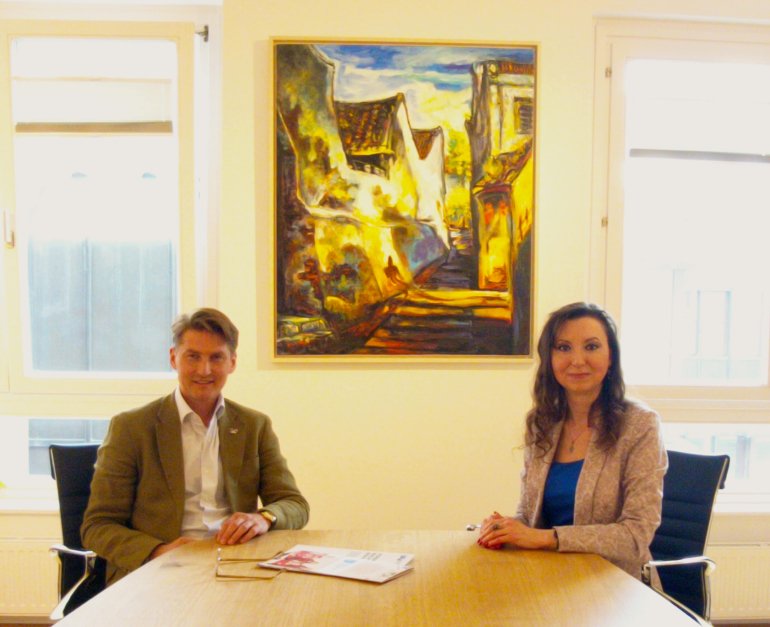
I came to the real estate business because I was hired by a private investor group, and that was my first truly impressive experience. It was the moment that created this passion. They invested in a very particular asset class in Vienna, the so‑called Zinshäuser, which are old residential buildings. That is where I learned that history and remarkable buildings have their own valuation. It is not only driven by figures, numbers, and utility. It is also driven by emotion. For instance, the building where we are having this interview is the former private residence of the Austrian emperor, Stefan Habsburg‑Lothringen. On the first floor you can still see the apartment exactly as it was. It looks as if the emperor has just left the room. That is something you cannot fully comprehend with spreadsheets. If you can share a room with the former emperor of a major European empire, that has its own value. It cannot be calculated. I had to learn that, and I still admire it. From that time on, I understood that real estate has a similarity to art. Every piece of real estate is unique and valuable. That uniqueness makes it interesting. You always have to adapt to a new project, to a new building, and you will never be able to compare real estate projects one hundred percent. There will always be something different, even if only slightly.
What lessons from your early years continue to influence you today?
One of my first lessons was to always be proactive. Start early, take initiative, be ambitious, be courageous, and try things out. You always have to factor in that some things will not work as planned. That is part of the business, and you learn the most along the way. This was something I learned right at the beginning of my career, and it is still one of the most important lessons I share with my employees today.
At what point did you decide to establish your own company? And what motivated you to take the entrepreneurial path?
At the end of my most intensive period of employment between 2006-2013, I decided to take that step. By then I had roughly seven years of real estate experience, and I felt that my level of expertise was mature enough to make it on my own. I started with smaller clients, and over time the clients became larger and the projects more complex. I have never regretted that decision.
What were the biggest challenges during the early years of building your business, and at what point did you realise that the company would succeed?
I would say the most difficult part in the beginning was that I started with real estate consulting. I was looking for clients who had a lack of knowledge, and I wanted to fill that gap. But consulting is a business where you constantly have to justify why you are needed. Before clients understand what you bring, you often have to deliver a large part of your knowledge so they can see what they were missing. The challenge is that people often do not know exactly what they are missing. They only know that something is not working and that they need external support. Learning how to acquire business in this environment was something I really had to struggle with at the beginning. It is the first important step you must learn. After a few years, I realized that once you have your first satisfied client, that client encourages his best friend, and those friends encourage their friends. Today we have a large network of clients who are very happy to work with us. We hardly spend anything on marketing because people know us through someone who has already worked with us.
Entrepreneurship often requires resilience. What values did you want your company to embody from the very beginning, and what does leadership mean to you?
Leadership to me means empowering my team in a truly mutual way. It is not only about giving people tasks. It is also about giving them perspective, giving them credit for their accomplishments, and giving them the freedom to choose their own way of doing things. Sometimes I even let team members follow their own path when I already know it may not end well. But it is their experience, not mine. I can tell them that I know a shortcut, but real empowerment means allowing them to learn through their own decisions. What I look for is commitment. I want every team member to be an entrepreneur in their own right. People need to be proactive. They should never come to me with only a problem. They should come with a problem and a solution. That is what leadership is about. Otherwise, you are not multiplying skills and resources. You are only adding something to your own limited capacity. But if you encourage people to think independently and act independently, that is when leadership truly makes sense.
Let’s talk about values. What are the most important values for you as a leader?
My most important values are credibility, a high standard of expertise, and consistency. When you encourage people to follow certain principles or develop certain habits, you must embody those principles yourself. Consistency is essential, because only over time does it build trust. In our business, clients often cannot fully understand what we are doing. They see the results, the papers, the presentations, the tables, but they cannot always grasp the full complexity behind them. In the end, they look into my eyes and ask whether this is the best we can deliver. When I say yes, they rely on that. They make decisions based on our work. That level of trust can only be built through consistency. And that is why I consider it one of my key values as a leader.
On your website, you have a definition of success: “Success is when the client's enthusiasm is reflected in their shining eyes.” How did this philosophy develop, and has your understanding of success evolved over time? And also, how do you measure success today? Has it changed, or maybe not?
I think what you just mentioned is exactly right. One of our core principles is that we want to create enthusiasm, because that is really the highest standard of success. When people are enthusiastic about something, they create energy and momentum. They inspire others, and they are able to lead others. When you encourage people and you see that moment when they understand something or when they discover something special, that is where enthusiasm becomes an essential factor. We always look for that. I can remember many moments when our clients felt this kind of satisfaction, and for me that is still one of the clearest indicators of success.
Innovation and digitalisation have become central themes of your work. Why are they so important to you, and what innovations have the potential to reshape real estate most profoundly?
Innovation is a bold word. It has almost become inflated, because people tend to call anything that works for the first time an innovation. But true innovation is not created easily. It often evolves slowly, and sometimes it appears in very unexpected ways. New ideas can emerge in many different settings, but the truly groundbreaking ones are often created in silence, in moments of deep focus. Brilliant ideas can even appear late at night when you cannot sleep, and suddenly something comes to you that is genuinely new. Innovation can mean creating something entirely new, but it can also mean understanding something better or seeing it more clearly. Both are incredibly important. We also work with many clients in education, so we often think about how the real estate industry can foster an atmosphere of creative thinking. That is a fascinating question, and one we will continue to explore. This is also where technology comes into play. We have to think about how we can make use of the technologies available to us. AI is obviously a revolution, and it will affect the real estate industry just as it affects every other industry. Everything related to standardized processes and repeatable tasks will be influenced by AI, and all of those conclusions apply to real estate as well. Right now we are focusing heavily on AI in our services, and we learn something new every day. It is an exciting journey.
I couldn’t agree more. What do you think, what opportunities artificial intelligence will create or has created for the real estate industry? And could AI eventually become a trusted advisor in major real estate transactions?
Yes, of course. AI is already our copilot. I think Microsoft chose a very clever name for its large language model by calling it Copilot. All other LLMs today are also in this co‑pilot mode. They take an important seat next to you. They do not simply observe; they actively participate in the decision‑making process, and that will become increasingly important. However, I do not believe that real estate is in danger of becoming fully optimized or fully automated. Real estate is a tangible asset, and it is closely connected to people’s privacy and personal environments. There will always be a human in the loop. That is my personal conviction. But on the way to that point, we will see a shift: the real estate advisor will be at the beginning and at the end of the process, and in between there will be a great deal of AI. That is a long path, but it is already visible. Overall, I believe AI will create far more opportunities than risks. I am optimistic about that.
In 2022, you became president of the FIABCI Austria. What did that appointment mean to you personally, and what vision did you have when you assumed the presidency?
I was very grateful to be selected, because the FIABCI family is a network that represents the entire ecosystem. Investors, service providers, banks, lawyers, and tax advisors are all part of our association. This means the presidency also carries a responsibility for the real estate industry in Austria. FIABCI Austria is the oldest real estate association in the country. My predecessor, Mr. Eugen Otto, is one of Austria’s most successful and widely respected real estate entrepreneurs. I was fortunate to inherit an association in excellent condition, strong, reputable, and exceptionally well positioned for the future. So the only thing I had to do was take the steering wheel and start driving. And that is exactly what I did.
FIABCI connects professionals from many countries. What benefits does this organisation provide, and what role do organisations, such as FIABCI, play in shaping industry standards and best practices worldwide?
I think there is tremendous potential to shape industries by strengthening connections, because many of the challenges we face are remarkably similar around the world. These are global problems, and FIABCI, as a network, is able to bring those threads together, connecting experts from different countries and different markets and serving as a platform for genuine professional exchange. That is something we can truly deliver. We also need to redefine our role within an increasingly digital world. Although we are an established association, we now operate in a landscape filled with many new initiatives, which means we must continually redefine our position and relevance within the global network. I believe we succeeded in highlighting that we are a network of people, built on genuine human connection. We do not rely on an app, nor do we depend solely on Facebook or LinkedIn posts. Instead, we want to encourage our members to travel, meet, and exchange with one another in person, which, in a way, stands in deliberate contrast to the digital world. At the same time, we must remain aware of this digital reality, because the most meaningful form of communication still happens when people sit next to each other. If a screen were between us, we would not be able to communicate the way we do now. The interview would have a different rhythm, and a different energy. Being physically together truly makes a difference, and that is what we will continue to focus on. FIABCI will never be a community of millions, even though millions of real estate businesses exist worldwide. Instead, we aim to be the community known for excellence, for genuine exchange, and for top‑level leadership. That is our purpose.
Why do people choose to join FIABCI, and why do FIABCI members want to collaborate?
I think it’s because we have always fostered genuine mutual exchange. In many ways, we are like a family — and I say that intentionally, because I have known some FIABCI members for decades. It is truly special to belong to a community that reaches across the entire globe. That sense of closeness within an international network is rare, and I believe it is what people value most. And of course, everyone knows that by joining FIABCI you gain access to leaders, to interesting projects, and to real business opportunities.
What have been the most rewarding aspects of leading FIABCI Austria, and how has working with professionals from around the world influenced your perspective on leadership?
I would say I've learned that, for instance, the Congress that we were organising is truly a team effort. And we have been planning this world congress for two years and as I see now what we have reached through our planning, I see lots of ideas that really went very well. We created this conference principle “ACT,” simple and clear. It can be an acronym, it can be something activating. And I'm extremely happy that many speakers took that opportunity to incorporate that into their content, and it fitted very well to our strategy to get people engaged. And I think we made it. I think social media attention went up by 10 times last week for our FIABCI community, and that's exactly what we wanted to and that's something I'm very happy about.
And I wanted to refer to that. The 76 FIABCI World Congress has just concluded, and it turned out to be a huge success. What does this achievement mean to you, and what are you most proud of regarding the Congress?
For me, the first priority was to create an event built on real connection, with an atmosphere where people genuinely meet, engage, and feel part of something meaningful. I wanted crowded rooms, lively lunch breaks, and vibrant evening events. I wanted people to feel that FIABCI is relevant, that something meaningful is happening here. There is nothing more discouraging than an empty or half‑empty room, and that was something we were determined to avoid. I am very proud that we achieved exactly that. We created this sense of energy and engagement, and we activated people to participate. That may be the biggest accomplishment of all. And if this Congress becomes a starting point, a benchmark that inspires future real estate conferences to be equally successful or even more successful, then that is something I would be proud of for many years to come.
What message do you hope international delegates take away from the Congress and from Vienna?
I hope people realise that even a small country, and there are many small countries around the world, can play a truly global role. We can be places of dialogue, and we can be role models in specific areas. Look at Taiwan, a very small country, yet at the forefront of semiconductors and many other industries. That is something I wanted all participants to understand: that dialogue will always be essential. People want mutual exchange, and this kind of communication is the foundation of our society. It is also the basis for creativity and innovation.
What key themes, do you think, dominated the conversations?
Interestingly, there are a few topics. I would say the first one is AI. It is so fast and so dynamic, and every week there is something remarkable to explain and to discover. The second topic is demographics. The demographic shift was mentioned by several speakers, and I think it has not yet been fully understood or fully considered in real estate. It seems like a very long‑term development, but it is a dramatic one, and real estate is always about long‑term perspectives. Demographic change does not transform society from one day to the next, but it will shape the real estate needs we will have in ten, twenty, and thirty years. And that affects the projects we start today. For me, these two topics were the most important ones.
I really enjoyed the panel featuring you, together with Rainer Rabenstein, Executive Advisor and Founding Board Member of Bartholdi Labs, and AI as a live participant. Did anything surprise you about having AI there with you in real time?
I wanted to know whether AI can also be part of this area of our lives. AI somehow aims to behave like us, and I was curious to see whether that also fits into the setting of a conference. For me, it was the first experience and the first experiment of this kind.
I love that because you introduced something completely new to everyone in the room, and it came across as very creative.
And I think it was interesting to see, and I really liked it. It was also unexpected for me. We asked live questions to the AI voice present in the room. I think it is obvious that AI is now a permanent part of our business. It will not go away, and it is already shaping how we work. I liked it.
Me too. It struck me as both courageous and remarkably innovative, and I genuinely loved that element of the panel. Your career has taken you from banking and consulting to entrepreneurship, and you also run the international organisation right now. Looking back, what has been the common thread connecting all these chapters of your life?
I would say there is no common bridge that takes you from one chapter to the next. But there was always a connection between one development and the other. If I had to give career advice to someone, I would say this: if you have a good start to your career, if you begin with something you admire, something you like, something you feel enthusiastic about, then remember that the first moment of discouragement or frustration will come. It happens to everyone. Nobody experiences a perfect, uninterrupted flow of motivation and tasks, or at least very few people do. At some point you will think: Is this really the right thing? Was this the wrong decision? I don’t like my boss, I don’t like my colleagues… And when you start thinking about change, try to take something from your past with you. Don’t change your role, your business, your industry, your location, your partner, your apartment, everything at once. You need something that stays connected to your past, because you cannot simply break your life into two parts and say, “This is now completely over.” Some people do that, and sometimes it is necessary, but it is a very risky step. I would only recommend such a complete break if you did not have a proper start and you feel you must reset everything. But if you have done something that created value, then try to connect it to the next step. One step should lead to another. The big jumps, from one world to a completely different one, may be challenging. And if you had asked me twenty years ago whether I would be sitting here today having this conversation with you, I would never have imagined it.
What has been the most difficult leadership decision in your life? And what did it teach you?
I’d say there have been several difficult leadership decisions. Some projects reached a point where problems and risks became very real, and having those difficult conversations needed courage, maturity, and preparation. I would never go into a difficult conversation without making notes beforehand. But these are exactly the moments where you grow. You don’t grow from simple tasks you repeat every day. You may become more efficient, but true development into a mature leadership personality comes from facing the hard conversations. And you should not outsource those difficult topics to colleagues, superiors, or anyone else. Take responsibility for them yourself. These are the conversations that help people grow.
Which books have had the greatest influence on your professional development?
From Good to Great by Jim Collins. A great, fantastic book. And of course Stephen Covey’s The 7 Habits of Highly Effective People. That is a very good book as well. I think these were the most important ones for me.
What do you think about mentorship? Are there any mentors you would like to mention?
I’ve been fortunate to have, in every phase of my life, a personality I truly admired. Already at school I had a few teachers who influenced me deeply, and one of them, the director of my school, gave me a lot of attention. I had a personal relationship with him and that mattered. Later, throughout my business life, I would say I had two mentors whom I can still call today Wolf-Dietrich Schneeweiss and Eugen Otto. And they know they are my mentors. When I reach out, they understand that I am not asking for consulting or a systematic process. I am asking for a sparring partner. Someone who can give me a second voice, someone I can ask: Am I missing something? Am I seeing this correctly? What I learned very early is that having a mentor is incredibly valuable. A mentor shortens your learning curve. You can take shortcuts you would never find on your own. But it is not easy to find someone you trust so much that you follow their advice even when you do not fully understand it or agree with it, simply because you respect them. Many people struggle with that. They feel they would lose their own personality or that they have not achieved something on their own. And then they do the opposite and repeat the same mistakes. I really like the idea of mentorship. The relationship between a master and a student is the most effective way to transfer knowledge. There is no book, no app, no learning platform that can replace the depth and impact of a true relationship between two people.
What trends will define the global real estate industry over the next decade?
The real estate business will continue to globalize. Things are becoming more connected, and assets can be transferred more easily from one economic system to another. We now have tokenization and blockchain technologies, and we have a global community that is already trading real estate across borders. So I believe real estate will become more and more global. Real estate will also intersect with many technologies. Technology has always been an important part of real estate development. However, if you look back over the last twenty years, not many technologies have actually stayed in the market and become part of sustainable development. There were many technologies that we no longer use or that never became truly relevant. The real estate business is also a little resistant to new technologies. When you experience a building like this one, you see something created by an architect who died two hundred years ago. The impact of real estate is extremely long‑lasting. You do not experiment lightly. You do not say, let us try something and see what happens. You only integrate something into a project if you believe it truly adds value. Not because it is part of a trend or because everyone else is doing it. That is not good advice.
And the last question. How do you see Austria's position within the European real estate landscape? And what makes the Austrian real estate market, including Vienna, attractive for international investors and businesses?
That is a very difficult question. First of all, geographically, we are in a sweet spot between North and South and between East and West. We are a neutral country, and we are very resilient. Austria is not a volatile market. It does not jump up fifty points and then drop sixty points the next year. It is a very stable market. If you look for stability, if you look for security, if you look for what some investors call good old Europe, then Austria and Vienna are very strong choices. Things do not change so fast here. People know what they get. These qualities will always be attractive to the international community. We will never be a hotspot for technology. It is unrealistic to think that we will become the leading edge of AI or similar fields. I do not believe in that. But Austria will always be interesting for people who believe that culture can only be experienced in certain places. Culture is something you experience outside the digital world. It cannot be easily transferred to another society or another location. The Vienna State Opera is one of the most successful opera houses in the world. I would say it is among the three leading opera houses globally. It attracts many artists to Vienna, but it also attracts tourists, business people, and expats to stay in Vienna because they can listen to an opera almost every night. If you ask any city whether they would like to have such an institution, everyone would say yes. But it is not easy to create something like that. It is an ecosystem. It is the university, the schools, the boys’ choir, and the monuments that remind us of the many artists who lived and created music in Vienna. What you see today as Vienna’s cultural and musical identity has at least three to four hundred years of history. It cannot be easily replicated. And we should not destroy it. We should preserve it.
Thank you so much.
You are welcome.
It was a pleasure speaking with you. That was Matthias Gass, President of FIABCI Austria, Founder & CEO of Gass Immobilien


Comments