




Key Takeaways from the 76th FIABCI World Congress 2026: Global Real Estate Trends Shaping the Future of the Industry

The 76th FIABCI World Congress in Vienna, organised by FIABCI Austria under the leadership of Matthias Gass, brought together 850 leaders from fifty‑one countries at a moment when global real estate is undergoing a profound transformation. The Congress was executed with remarkable precision, demonstrating an exceptional level of organisation down to the smallest detail. FIABCI International was represented by World President Antonio Campagnoli, who led the organisation throughout the Congress before formally handing over the presidency to Lily Chang.
As Editor-in-Chief of BUSINESS POWERHOUSE, I was on site throughout the week, observing the discussions firsthand and engaging directly with industry voices shaping the future of development, investment, and urban strategy. What became clear to me across five days of high‑level dialogue is that the sector is entering a new era defined by sharper economic realities, accelerated technological disruption, and rising expectations from investors, regulators, and communities alike. What emerged in Vienna was not simply a collection of conference insights, but a clear blueprint of what the world’s most influential real estate decision‑makers are prioritising now and what will shape the next decade of real estate development, investment, and urban strategy.
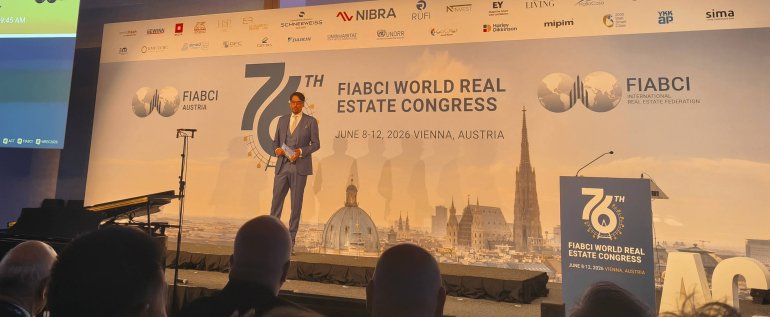
Table of Contents
- ACT: The Framework Guiding the 76th FIABCI World Congress
-
8 Key Takeaways from the 76th FIABCI World Real Estate Congress 2026
- Vienna and Austria Stand Out as Stable, Predictable Markets for Global Capital
- Housing Affordability Moves to the Top of the Global Agenda
- The Future of Business Is Urban
- Secure AI Adoption Requires Data Sovereignty
- Collaboration as a Driver of Industry Strength
- The Skills Gap Is Reshaping Real Estate Careers
- Regulation Shapes Where Innovation Happens
- Decision Making Requires Clarity, Trust and Presence
-
Frequently Asked Questions About the 76th FIABCI World Congress
- 1. What were the main themes of the 76th FIABCI World Congress?
- 2. Why is housing affordability a global real estate priority?
- 3. How is urbanization changing the real estate industry?
- 4. What role will artificial intelligence play in real estate?
- 5. Why is data security important when adopting AI in real estate?
- 6. Why is the FIABCI World Congress important for the real estate industry?
- 7. What are the biggest global real estate trends in 2026?
- 8. Who should read the key takeaways from the FIABCI World Congress?
- 9. Why do the insights from the FIABCI World Congress matter beyond the real estate industry?
From housing affordability and demographic shifts to AI‑driven innovation, sustainability, and cross‑border capital flows, the Congress revealed the themes that will define the real estate industry in 2026 and beyond. This article distills the most important takeaways for developers, investors, policymakers, and city leaders navigating a rapidly evolving global real estate landscape.
ACT: The Framework Guiding the 76th FIABCI World Congress
Under the guiding theme ACT – Action. Collaboration. Transformation., the 76th FIABCI World Congress set the stage for progress and meaningful change. ACT served as a strategic framework shaping discussions across keynotes, panels, and breakout sessions. According to FIABCI Austria, “ACT reflects a commitment to progress and collective impact.” This theme captured the FIABCI real estate community’s shared commitment to taking action focused on turning ideas into reality, strengthening collaboration through global partnerships, and accelerating the transformation of the real estate industry towards a sustainable future.
Action: Turning ideas into impactful reality.
Leaders emphasised that the industry can no longer afford long cycles of debate without implementation. From housing solutions to digital adoption, the focus has shifted decisively toward execution, measurable outcomes, and initiatives that deliver tangible value to cities and communities.
Collaboration: Achieving progress through global teamwork.
With markets facing shared challenges — affordability, demographic shifts, regulatory pressure — collaboration has become a strategic necessity. The Congress reinforced FIABCI’s role as a global connector, enabling cross‑border partnerships, knowledge exchange, and coordinated action across public and private sectors.
Transformation: Embracing innovation for a sustainable future.
From housing, AI to ESG‑aligned development, transformation is reshaping the industry’s foundations. Leaders highlighted that innovation is no longer optional; it is the pathway to long‑term competitiveness, resilience, and environmental responsibility.
Together, these three pillars: Action, Collaboration, Transformation formed the backbone of the Congress and the lens through which all subsequent discussions and takeaways were framed.
For background on the Congress, see our preview article 76th FIABCI World Real Estate Congress Set to Convene Global Real Estate Leaders, 8–12 June 2026
Back to top8 Key Takeaways from the 76th FIABCI World Real Estate Congress 2026
The conversations in Vienna made it clear that the industry is navigating a moment defined by complexity, acceleration and shifting global priorities. Across panels, presentations and informal discussions, leaders repeatedly returned to one central theme: real estate decisions today must be grounded in clarity, resilience and long‑term strategic thinking. This set the stage for several key insights that emerged throughout the Congress, beginning with the question of where international real estate is moving now.
Vienna and Austria Stand Out as Stable, Predictable Markets for Global Capital
In periods of global uncertainty, international capital consistently seeks markets that offer stability, clarity and long‑term resilience. David Zechner of NT‑Invest emphasised that Vienna and Austria provide exactly this combination. Strong fundamentals, steady long‑term growth and a reliable regulatory environment make the country one of Europe’s most trusted destinations for real estate investment.
Vienna remains relatively affordable compared to other major European capitals. Although prices have softened recently, they are expected to strengthen again, creating a favourable entry point for investors who understand cyclical dynamics and prefer to position themselves before the next upward movement. Austria’s regulatory framework, often perceived as strict by international investors, is precisely what contributes to the market’s predictability. Clear rules, consistent enforcement and a long tradition of stability reduce volatility and support long‑term value creation.
Zechner captured the essence of the moment in one line: “In times of uncertainty, international capital naturally returns to trusted and understandable markets.” Vienna’s combination of affordability, regulatory clarity and long‑term resilience positions it as a strategic choice for investors seeking dependable markets with future upside.
The takeaway is straightforward. Vienna and Austria offer a rare blend of stability and timing advantage. For global investors seeking secure markets with long-term potential, now is the moment to act rather than wait.
For a deeper look at Austria’s role in the real estate luxury segment, see Austria’s Luxury Real Estate Position in Europe: Key Market Insights for 2026.
Housing Affordability Moves to the Top of the Global Agenda
One of the strongest messages emerging from the 76th FIABCI World Real Estate Congress was that housing affordability has become one of the defining global challenges of our time. Far beyond a social policy issue, affordable housing is increasingly recognized as a cornerstone of economic resilience, sustainable urban development, and long-term global stability.
During her keynote address, Anacláudia Rossbach, Executive Director of UN-Habitat, emphasized that addressing the global housing deficit requires far greater alignment between governments, cities, financial institutions, investors, developers, and local communities. She argued that the housing crisis should not be viewed simply as a market failure but as the result of deeper structural challenges.
"The global housing crisis is the result of a structural policy gap, a gap in governance, a gap in finance, and a misalignment between where the need is and where the investment goes," Rossbach noted. "The real estate industry is not a bystander in closing this gap. It is an essential partner in delivering adequate housing solutions."
Her remarks underscored an important shift in thinking. Housing is no longer viewed solely as a social responsibility but as a macroeconomic, climate, and stability issue that directly affects productivity, investment, social cohesion, and the resilience of cities.
Ms Rossbach also called for a broader and more diversified approach to housing delivery. Rather than relying exclusively on traditional development models, she encouraged governments, banks, development finance institutions, and private investors to support a wider range of solutions. These include incremental and self-built housing, settlement upgrading, rental and social housing, housing cooperatives, and community land trusts. Achieving meaningful progress, she argued, will require stronger collaboration between the public, private, and community sectors, supported by innovative financing mechanisms such as microfinance and blended finance.
For business leaders and real estate professionals, the message was clear: solving the global housing challenge will demand cross-sector partnerships, innovative investment models, and long-term strategic thinking. Housing affordability is no longer a peripheral issue. It has become one of the central priorities shaping the future of cities and the global real estate industry.
This is one of the strongest strategic themes from the Congress because it extends beyond real estate into business strategy, geopolitics, and urban economics. Rather than simply reporting what was said, position it as a major shift in how leaders should think about markets.
The Future of Business Is Urban
One of the most thought-provoking perspectives at the 76th FIABCI World Real Estate Congress came from global business guru Kjell A. Nordström, who argued that the future of business will increasingly be shaped not by countries, but by cities.
His message was simple yet profound: people move and they overwhelmingly move to cities. Urban areas continue to attract talent, investment, innovation, and economic activity at an unprecedented pace. While only around 10% of the world's population lived in cities a century ago, that figure surpassed 50% in 2006. Today, approximately 60% of humanity lives in urban areas, and by 2045, Nordström expects that nearly 80% of the global population will call cities home.
This rapid urbanization is transforming the way governments, businesses, and investors operate. As populations become increasingly concentrated in major metropolitan areas, political priorities, infrastructure investment, and economic policy will inevitably follow where people live.
Nordström illustrated this trend with examples from around the world. In Sweden, more than half of the country's population is expected to live in the Stockholm metropolitan area. Japan is experiencing a similar concentration, with a growing share of its population projected to reside in the Tokyo region over the coming decades. Perhaps his most striking observation was that many multinational corporations are beginning to rethink how they define their markets.
"We are not a multinational company anymore," Nordström recalled one executive saying. "We are a multi-urban company."
Rather than viewing countries as their primary markets, global companies increasingly focus on the world's leading metropolitan regions. Manufacturing, headquarters, talent acquisition, customer engagement, and innovation are concentrated in major cities such as Istanbul, Tokyo, London, Singapore, and New York, where economic activity is densest and opportunities are greatest.
For the real estate industry, this shift carries profound implications. As cities continue to grow, demand for housing, commercial developments, mixed-use districts, transportation infrastructure, and sustainable urban planning will intensify. Investors and developers will need to think beyond national borders and understand cities as the primary engines of economic growth.
The takeaway was clear: the future belongs to cities. For business leaders, investors, and real estate professionals alike, understanding urbanisation is no longer optional. It is essential for anticipating where capital, talent, innovation, and opportunity will converge in the decades ahead.
Secure AI Adoption Requires Data Sovereignty
Artificial intelligence continues to transform industries worldwide, but one of the key discussions at the 76th FIABCI World Real Estate Congress focused on a critical question facing organisations today: how can businesses harness the power of AI while protecting their most valuable asset: their data?
The consensus was clear: successful AI adoption depends not only on the capabilities of large language models but also on ensuring that sensitive corporate information remains secure and under the organization's control. Many companies are increasingly turning to on-premise AI solutions and locally hosted language models. Unlike public AI platforms, these systems operate behind corporate firewalls and within private virtual networks, allowing organizations to define exactly which documents, databases, and knowledge repositories the AI can access.
This approach enables businesses to benefit from AI-powered insights and automation while maintaining strict governance over confidential information. Rather than exposing sensitive data to external environments, organizations can deploy AI within secure infrastructures that align with internal security policies and regulatory requirements.
For industries such as real estate, finance, construction, and infrastructure, where confidential contracts, investment strategies, client information, and proprietary market intelligence are core business assets, data sovereignty is becoming a strategic priority.
The discussion highlighted an important evolution in enterprise AI. The question is no longer whether companies should adopt artificial intelligence, but how they can implement it responsibly, balancing innovation with security, compliance, and trust.
As AI becomes increasingly integrated into business operations, organisations that establish secure, well-governed AI environments will be better positioned to accelerate innovation while protecting one of their most valuable competitive advantages: their data.
Collaboration as a Driver of Industry Strength
Collaboration emerged as one of the most resonant themes at the 76th FIABCI World Congress. Entrepreneur and digital pioneer Florian Gschwandtner reminded the audience that meaningful progress rarely happens in isolation. His perspective carries particular weight because his own career is built on the power of a strong team.
In October 2009, Florian co‑founded Runtastic together with Christian Kaar, Alfred Luger, René Giretzlehner and another colleague. The company began as a small health and fitness venture financed through the development of apps and digital products for Austrian telecom operators. What started as a modest project grew into one of Europe’s most successful mobile fitness platforms. In August 2015, Runtastic was acquired by the Adidas Group for 220 million euros. This journey illustrates how collaboration, shared vision and complementary strengths can transform an idea into a global success story.
Florian expressed this belief clearly in his own words: “Together everybody achieves more. So that is my biggest belief that one plus one equals three if the right people at the right time are getting together.” His statement captured the spirit of the Congress, which brought leaders from more than fifty countries into one space to exchange ideas, build partnerships and accelerate innovation.
He also noted that the beginning was not easy. Teams do not form instantly, and trust requires time and persistence. His reflection added an important layer to the conversation. Collaboration is powerful, but it demands commitment, patience and the willingness to learn from others.
The takeaway is clear. The future of real estate will be shaped by teams that combine expertise, creativity and diverse perspectives. Markets are becoming more complex, and the challenges ahead require coordinated action rather than isolated effort. The strongest outcomes will come from partnerships that bring the right people together at the right moment.
The Skills Gap Is Reshaping Real Estate Careers
The global real estate industry is evolving at a pace that traditional education models can no longer match. Artificial intelligence, ESG regulation, digital transformation, demographic change and shifting workplace expectations are redefining the capabilities required for successful careers, particularly in the United States. Dr David Steiner highlighted how planning horizons have compressed. What once was a ten or fifteen-year outlook has become five years, and even that may soon be too long. He captured the urgency clearly when he said, “The changes are getting faster and faster, and we are not sure that five years is still enough.”
Sonja Steinmetz of BUWOG offered a candid perspective on the realities of recruitment. Junior positions are less common than they were five to ten years ago, and her company hired only two juniors this year. She emphasised that a real estate degree still signals profound knowledge and gives employers a clear expectation of what a candidate should understand. Yet experience remains essential. She expressed this clearly when she said, “A degree shows us profound knowledge, but experience is very important. It helps us understand how a candidate deals with specific situations.”
Sonja Steinmetz also highlighted the value of part‑time work, internships, project involvement and university collaborations. These experiences give candidates practical insight and provide companies with fresh input at a time when the industry is changing rapidly.
The takeaway is very clear. The strongest candidates will be those who combine academic grounding with practical capability. Real estate careers now require adaptability, hands‑on experience and the ability to respond to a sector that is evolving faster than ever before. Closing the skills gap will require closer cooperation between universities, employers and students who are ready to learn in real environments.
Regulation Shapes Where Innovation Happens
Lars P. Feld, one of Germany’s leading economists, delivered a clear and data‑driven message at the Congress. Regulation is not an abstract policy concern. It is a decisive factor that determines where innovation takes place, where investment flows and where companies choose to grow. Labor market rules, compliance costs and employment protection legislation directly influence the attractiveness of a country for high‑risk, high‑potential ventures.
He illustrated this with comparative severance pay data from a recent study by two French economists. The cost of laying off one worker is two and a half months of salary in Switzerland, 3.3 months in Denmark, six months in the United States, ten months in Sweden, thirty‑one months in Germany, about forty months in France, more than fifty months in Italy and more than sixty months in Spain. These differences are not marginal. They shape strategic decisions. As Feld explained, companies with breakthrough innovations do not choose markets where labor adjustments are prohibitively expensive. They go to the United States, Denmark or Switzerland, where regulation allows flexibility and where investment can respond quickly to opportunity.
Feld captured this reality in a single line that resonated strongly: “Finance follows the opportunities for real investment. Real investment is taking place because of differences in regulation.” That idea is very visible in Europe’s innovation landscape. Countries with flexible regulation attract innovation, investment, followed by growth, showing higher investment, stronger productivity and more dynamic startup activity, while countries with rigid regulation struggle to scale new ventures, even when talent and ideas are present. Europe’s challenge is not a lack of ideas or talent, it is the regulatory environment that slows growth and reduces the scale of new ventures, limiting Europe’s ability to innovate at speed.
The takeaway is unmistakable. Regulation is a strategic determinant of economic dynamism. Countries that want to attract innovation, investment and high‑growth companies must create environments where risk is possible, adjustment is manageable and compliance does not overwhelm productivity as finance follows opportunity, and opportunity follows regulation. The future of real estate and the broader economy will be shaped by how governments respond to this reality.
Decision Making Requires Clarity, Trust and Presence
Former DFB referee Lutz Wagner offered one of the most memorable reflections of the Congress. His perspective on decision making, shaped by years on the football pitch, translates directly into leadership, business and real estate. Decision making is never simple, and it becomes even more demanding when time pressure, emotions and high stakes are involved. Wagner reminded the audience that leaders must understand their own decision‑making style, their strengths and the areas they can improve.
He explained that in environments where money, risk and strong emotions are present, the ability to guide others out of emotional reactions and into constructive dialogue becomes essential. Leaders who can create this clarity become winners in complex situations.
Wagner also highlighted the importance of trust and transparency. He used the example of referees who now walk to the monitor and allow the audience to see the review process. This simple act changes how people perceive the final decision. They accept it because they have been taken along the path of reasoning. Wagner captured this principle in a powerful line: “If you take people with you on the way to the decision, they will accept it.”
Lutz Wagner then turned to a moment every leader knows. The group steps back, you stand in the middle, and everyone looks at you. This is the moment when the responsibility to decide becomes yours. Some people fear it. Wagner encouraged the opposite. This is the moment when you can shape the future. If you stand in the circle, others will decide for you. If you stand in the middle, you have the chance to lead.
He reminded the audience that preparation is essential. These moments define reputation, authority and the level at which a leader operates. Leaders are not only decision makers. They are also brand ambassadors. Wagner described how, as a referee, he enters the pitch and the fans shout. The reaction is emotional, but the responsibility remains clear. You must be ready to decide with confidence, transparency and presence.
The takeaway is obvious. Effective decision making requires emotional intelligence, trust building and the courage to step forward when others step back. Leaders who embrace these moments shape outcomes, strengthen teams and set the direction for the future.
Conclusion
The 76th FIABCI World Congress in Vienna made one message unmistakable. The global real estate industry is entering a period of profound transformation, shaped by new economic realities, rapid technological change and rising expectations from communities, investors and regulators. Across five days of dialogue, leaders from more than fifty countries demonstrated that the future of real estate will depend on action, collaboration, and transformation, making the ability to adapt with speed and confidence even more important.
Housing affordability has moved to the top of the global agenda. Innovation is accelerating in markets where regulation enables flexibility. Skills and talent are being reshaped by digital transformation and new workplace demands. Decision making is becoming more complex and requires clarity, transparency and emotional intelligence. These insights reflect a sector that is no longer defined by traditional cycles but by continuous evolution.
The Congress also showed that real estate is not operating in isolation. It is connected to macroeconomic stability, climate resilience, social equity and technological progress. The industry holds a decisive role in shaping cities that are inclusive, sustainable and economically vibrant. The leaders who gathered in Vienna demonstrated that progress will come from shared responsibility and from partnerships that bring together public, private and community actors.
The path ahead is challenging, but full of opportunities. The takeaways from Vienna offer a clear direction. Real estate must embrace innovation, strengthen collaboration and act with purpose. Those who do will shape the next decade of global development and set new standards, and will influence how the real estate industry will grow, adapt and thrive.
Back to topFrequently Asked Questions About the 76th FIABCI World Congress
1. What were the main themes of the 76th FIABCI World Congress?
The 76th FIABCI World Congress focused on the future of global real estate through discussions on housing affordability, urbanization, artificial intelligence, sustainability, investment, leadership, and innovation. The event emphasized collaboration between the public and private sectors to address the industry's most pressing challenges.
2. Why is housing affordability a global real estate priority?
Housing affordability has become a global priority because it affects economic growth, social stability, and sustainable urban development. Speakers highlighted that solving the housing crisis requires coordinated action between governments, investors, developers, financial institutions, and local communities.
3. How is urbanization changing the real estate industry?
As more people move to cities, demand for housing, commercial space, infrastructure, and mixed-use developments continues to grow. Business leaders increasingly view cities—not countries—as the primary centers of economic activity, investment, and innovation.
4. What role will artificial intelligence play in real estate?
Artificial intelligence is helping real estate professionals improve decision-making, automate processes, analyze market data, and enhance property management. The Congress also emphasised the importance of secure AI deployment that protects sensitive business data through strong governance.
5. Why is data security important when adopting AI in real estate?
Organisations increasingly use private or on-premise AI systems to ensure confidential information remains protected. Secure AI enables companies to benefit from automation and insights while maintaining control over proprietary data and complying with regulatory requirements.
6. Why is the FIABCI World Congress important for the real estate industry?
The FIABCI World Congress brings together developers, investors, architects, policymakers, urban planners, and other industry leaders from around the world to exchange knowledge, explore emerging trends, and build international business relationships. It serves as a global platform for discussing the future of the built environment.
7. What are the biggest global real estate trends in 2026?
Key trends include housing affordability, rapid urbanization, sustainable development, AI adoption, smart cities, resilient investment strategies, and increased collaboration between governments and the private sector. These themes were central to discussions throughout the congress and align with broader industry outlooks.
8. Who should read the key takeaways from the FIABCI World Congress?
The insights are valuable for real estate professionals, investors, developers, architects, policymakers, business executives, entrepreneurs, and anyone interested in the future of cities, property markets, and global investment.
9. Why do the insights from the FIABCI World Congress matter beyond the real estate industry?
The discussions at the FIABCI World Congress extend beyond property markets. Topics such as housing affordability, urbanization, artificial intelligence, sustainability, and investment influence economic growth, business strategy, public policy, and the future of cities, making these insights relevant to executives, investors, and leaders across industries.
Back to top


Comments